Quick Summary
Planning gas stops before a road trip can help you save money, avoid unnecessary stress, and prevent running out of fuel in unfamiliar areas. By mapping your route, calculating your vehicle's fuel range, researching gas prices, and preparing your vehicle ahead of time, you can create a smoother and more efficient travel experience. A little preparation can help you spend less time worrying about fuel and more time enjoying the journey
Quick Navigation
- Start by Planning Your Route
- Calculate Your Car's Range
- Price Gas by City
- Keep in Mind How Often You Want to Stop
- Prep Your Car
- Save Money on Your Road Trip by Planning Your Gas Stops
Road trips can be about getting to the destination, enjoying the journey or both — but no one wants to find themselves between towns with no gas in the tank. You can avoid this fate by doing a little planning and calculating before you start your adventure. For travelers considering longer journeys, exploring available RV financing options can provide greater comfort and flexibility on the road. Your journey will be much more enjoyable when you know you won't run out of gas and will have access to food and a restroom.
How Should You Plan Your Road Trip Route?
The first step in being prepared is to plan your route. This is the only way to ensure there are gas stops when you need them. Figure out which roads you're going to take, whether it's the fastest route offered by your GPS or the long scenic way.
You should consider if you want to make additional stops to experience museums, scenery or other local gems. The route may be taking you straight through somewhere you want to explore! Do a little research into the areas you are passing through. Finding a new stop may influence the path you take and the time you need to get where you're going.
Also, estimate when you will start your journey and when you should arrive. Remember to factor in time for multiple stops along the way for gas, food and restroom breaks. You may need to stop more often than just for gas, like if you realize you should have used the restroom at the last stop and can't wait for the next one.
Spend a little time figuring out when you will be in which area. This could affect your plan, like if some gas stations are closed at night in a certain town.
How Do You Calculate Your Car's Fuel Range for a Road Trip?
To figure out when and where you'll have to stop for gas, you need to know how far your car can go on a full tank of gas. You'll need to know the miles per gallon of your car and how many gallons your tank holds. Then, multiply the MPG by the number of gallons your tank holds.
For example, if your car gets 30 MPG and has a 12-gallon tank, your car should be able to go 360 miles on a fill-up. However, your actual mileage will vary so you should plan to fill up with around a quarter tank left, just in case. Multiply by .75 to find the optimum miles to go between gas stops. In this example, the answer would be 270 miles.
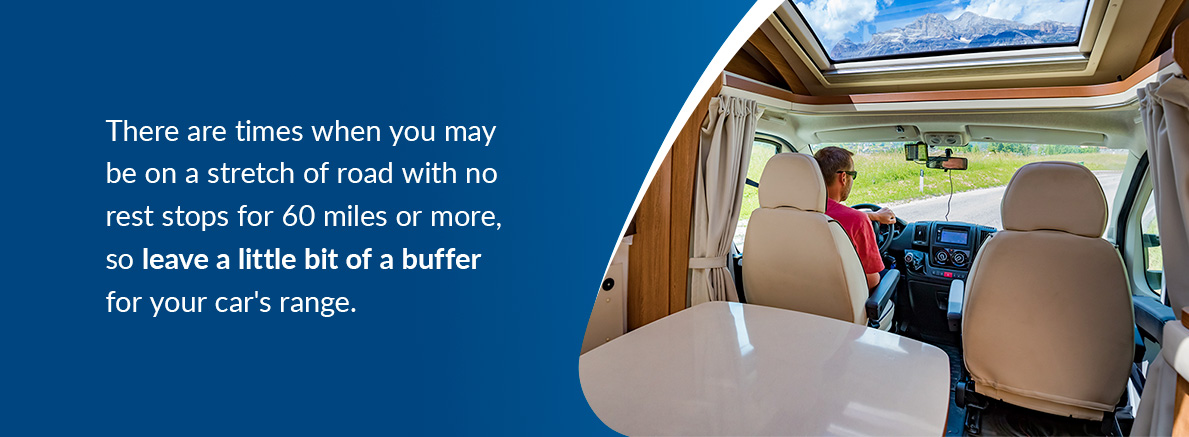
You can use your car's range to figure out approximately where and when you should stop for gas. There are times when you may be on a stretch of road with no rest stops for 60 miles or more, so leave a little bit of a buffer for your car's range. Your gas mileage will also vary depending on your speed and if there is traffic.
How Do Gas Prices Vary by City on a Road Trip?
Gas prices can often vary from place to place. If budget is important to you, you should do a little research to find out the gas prices around your route. There are certain apps and websites, like GasBuddy, that you can use to check current gas prices at different gas stations. You can check prices ahead of time to find general trends and see what places are cheaper.
When picking out gas stations that you may want to stop at, remember that not all gas stations are open 24 hours a day.
Keep in Mind How Often You Want to Stop
Some people like having frequent stops whenever they need something or see something they want to look at, while others like to streamline their road trip. If you stop often, your trip will take longer, but you may get to see more! You may find it more enjoyable to take your time and stop at a campground or motel for a night. This will give you extra time to explore your surroundings and give you a break from driving.
If you only want to stop when you absolutely have to, it's best to do everything each time you stop. Each time you stop for gas you should also go to the restroom and buy a snack if you didn't bring any with you. This prevents you from having to stop more often just to go to the restroom or eat.
If you find yourself having to make an additional, unplanned stop, don't worry. Even if you don't need gas yet, you may as well top off the tank.
How Do You Prepare Your Car for a Road Trip?
Your road trip will be much more enjoyable if you prepare. Other than planning around gas stops and bathroom breaks, there is some additional planning to do. Make sure your tires are fully inflated, your windshield wipers are working and you have an emergency car kit. An emergency car kit should include things like jumper cables, tools, a flashlight with extra batteries, reflective triangles, a first aid kit, reflective vests, a phone charger, duct tape, a fire extinguisher and a blanket. Remember to bring your license, registration and insurance information.
Long trips can be improved with a memory foam cushion, a cooler full of snacks, plenty of hydrating drinks and comfortable shoes and clothes. You may need sunglasses, a phone mount and an on-the-road music or podcast playlist. Since you'll be sitting for a long time, make sure you are as comfortable as possible.
How Can You Save Money on Gas by Planning Your Stops?
Planning when you want to stop for gas not only makes your trip easier, but it also saves you money. You can plan to hit the cheaper gas stations without having to go out of your way to find them. This can reduce the length of your trip and how much gas you use overall. Thinking ahead and bringing your own food is another way to save some money on your trip. Prepping your car for a long journey will also prevent potentially costly repairs if something breaks down.
Start Your Adventure With an RV Loan From My Financing USA

Looking to get an RV for your next road trip? My Financing USA specializes in boat and RV financing with low rates, credit protection and easy approval. We'll help you find the best deal even if you've had credit problems.
Get the RV you need to make your long road trips more comfortable and enjoyable. We also offer Guaranteed Asset Protection, RV Tire and Wheel Asset Protection and a Vehicle Service Contract that protects you in the event anything goes wrong during one of your adventures. You can also use the RV loan calculator to estimate monthly payments and determine a financing option that fits your travel budget.
Fill out an online application today, or contact us to discuss your options. Have questions? Find the answers on our FAQ page.
Additional Resources on Road Trips:
- How To Plan a Road Trip
- Road Trip Food and Snack Ideas
- Road Trip Game Ideas
- How to Find Safe Parking for Your RV
- How to Make Your RV Trips More Environmentally Friendly
- Common RV Mistakes and How to Avoid Them
FAQs:
How do you plan gas stops efficiently on a long road trip?
The best approach is to map your route in advance, calculate your vehicle's fuel range, identify fuel stations along the route, and build a safety buffer into your schedule. Many travelers prefer refueling when the tank reaches approximately one-quarter full rather than waiting until fuel levels become critically low.
How far can you drive before needing to stop for gas on a road trip?
The answer depends on your vehicle's fuel efficiency and tank size. By multiplying your vehicle's miles-per-gallon rating by the fuel tank capacity, you can estimate its maximum range. Most travelers plan fuel stops well before reaching the vehicle's theoretical maximum range.
What apps are best for finding cheap gas along your route?
Popular apps such as GasBuddy, Google Maps, Waze, and other fuel-price comparison tools can help travelers identify nearby gas stations, compare fuel prices, and locate convenient stops along their route.
How can you save money on fuel during a road trip?
Driving at consistent speeds, avoiding excessive idling, reducing unnecessary cargo weight, maintaining proper tire pressure, using cruise control when appropriate, and researching lower-priced fuel stations can all help reduce fuel expenses.
Should you fill up your tank before it gets low on a road trip?
Yes. Waiting until the fuel tank is nearly empty can increase the risk of being stranded in areas with limited services. Many experienced travelers prefer refueling when the tank reaches one-quarter capacity to maintain a comfortable margin of safety.
How do gas prices vary by location and how can you plan around them?
Fuel prices often differ significantly between cities, states, highway exits, and rural communities. Researching fuel costs ahead of time can help you identify lower-cost areas and plan refueling stops strategically to reduce overall travel expenses.
What factors affect your car's fuel range on a road trip?
Several factors can impact fuel range, including vehicle speed, traffic conditions, terrain, weather, vehicle weight, tire pressure, driving habits, and the condition of the vehicle. These variables can cause actual fuel range to differ from manufacturer estimates.